 Contec Cleanroom
 Life Sciences, Microelectronics, Cleaning, Residue Management, Webinar
Clean with Confidence: Understanding Detergents, Managing Residues, & Optimising Cleanroom Cleaning


Webinar Section Summaries
EU GMP Annex 1 Requirements for Cleaning and Disinfection
EU GMP Annex 1 establishes expectations for cleaning and disinfection programs in sterile manufacturing environments. Section 4 emphasizes that cleanrooms must be thoroughly cleaned and disinfected according to a written program, with prior cleaning performed to remove surface contamination before disinfection.
Cleaning programs must also address disinfectant residue removal to prevent interference with subsequent disinfection processes.
Key regulatory considerations include:
- Written procedures: Cleaning and disinfection must follow documented programs.
- Residue removal: Cleaning processes must remove residues that could interfere with disinfection.
- Sterility requirements: Detergents and disinfectants used in Grade A and B areas must be sterile before use.
- Risk assessment: The need for sterile solutions in Grade C and D areas should be evaluated based on facility-specific risks.
- Validated processes: Cleaning procedures must demonstrate effectiveness and repeatability.
- Contamination Control Strategy (CCS): Cleaning and disinfection activities must support the facility's overall contamination control approach.
Annex 1 establishes expectations without prescribing a universal cleaning method. Facilities must determine and justify appropriate procedures for their operating conditions.
Understanding the Difference Between Cleaning and Disinfection
Cleaning and disinfection are distinct processes that work together to achieve contamination control.
Characteristics of cleaning in cleanrooms:
-
Removes nonviable contamination
-
Uses mechanical action and cleaning agents
-
Removes particles, soil, and residuesRelies on physical removal
-
Prepares surfaces for disinfection
Characteristics of disinfection in cleanrooms:
-
Reduces viable microorganismsUses antimicrobial disinfectants
-
Achieves the required microbial reduction
-
Relies on validated antimicrobial activity
-
Controls microbial contamination
A successful contamination control program requires both processes. Inadequate cleaning can compromise disinfection, even when highly effective antimicrobial products are used.
Why Effective Cleaning Is Essential for Contamination Control
Effective cleaning is fundamental to achieving reliable disinfection because accumulated dirt, particles, and residues can prevent disinfectants from reaching microorganisms.
Surface contamination can include visible and microscopic particles, manufacturing residues, and deposits left by repeated disinfectant applications.
Important cleaning considerations include:
- Residues can create physical barriers between disinfectants and microorganisms.
- Sticky or accumulated deposits can reduce the effectiveness of subsequent disinfection.
- Cleaning must address both visible and nonvisible contamination.
- Procedures should be validated, repeatable, and performed by trained personnel.
- Environmental monitoring trends help evaluate the effectiveness of the combined cleaning and disinfection program.
Cleaning effectiveness depends on appropriate product selection, good surface contact, and consistent application techniques.
How Particles Adhere to Cleanroom Surfaces
Particles adhere to cleanroom surfaces through several physical mechanisms, making them difficult to remove without appropriate cleaning methods.
Four primary particle adhesion mechanisms:
- Gravity: Particles remain on surfaces due to gravitational forces.
- Electrostatic forces: Electrical interactions attract particles to surfaces.
- Van der Waals forces: Molecular interactions contribute to particle adhesion.
- Capillary forces: Microscopic liquid layers create adhesion between particles and surfaces.
Capillary forces are identified as a particularly significant contributor to particle adhesion.
Effective cleaning requires disrupting these forces and encouraging particles to transfer from the surface to the cleaning material.
Low-surface-tension fluids, including alcohols and detergent solutions containing surfactants, can help disrupt capillary adhesion. Mechanical action from wipes and mops further supports particle removal.
Evaluating Particle and Disinfectant Residue Removal Methods
Research comparing different cleaning methods demonstrates the importance of moisture and mechanical removal when addressing particulate contamination and disinfectant residues.
Particle removal evaluations compared methods including dry wiping, vacuuming, tacky materials, and presaturated wipes. Wet presaturated wipes provided the most effective particle removal across the evaluated particle sizes.
Separate residue removal experiments used fluorescent tracers and image pixel analysis to assess cleaning performance.
Re-solubilizing the disinfectant residue before removal produced the best results among the evaluated methods, although a specific percentage was not provided.
Key findings from evaluating particle and disinfectant residue removal methods:
- Dry wiping is less effective against dried, established residues.
- Moisture improves residue removal.
- Re-solubilization can improve the removal of dried disinfectant deposits.
- Residue removal methods should be evaluated against the actual products and surfaces used within a facility.
Strategies for Preventing and Managing Disinfectant Residues
Most disinfectants leave some form of residue following application. Residue accumulation can interfere with future disinfection, affect surface cleanliness, and increase the difficulty of routine cleaning.
Residue quantity does not necessarily determine how difficult a deposit will be to remove. Some products leave relatively large amounts of readily removable residue, while others produce persistent, sticky deposits.
Quaternary ammonium compound-based disinfectants are highlighted as a potential source of waxy, difficult-to-remove residues.
Three principal approaches to residue management:
- Removal after validated contact time: Remove the disinfectant once its required contact time has been achieved, before persistent deposits develop.
- Immediate residue removal stage: Use an appropriate agent, such as water or alcohol, to remove remaining deposits.
- Scheduled detergent cleaning: Allow residues to accumulate for a scientifically justified period, then remove them using a validated detergent cleaning process.
Water can be useful for residue removal but does not provide antimicrobial control when left on a surface. Alcohol can offer effective removal and rapid drying, but large-area use raises flammability and occupational exposure concerns.
The appropriate residue removal frequency should be determined through validation and risk assessment rather than assuming that cleaning is required before every disinfectant application.
Understanding Detergents and Their Role in Cleanroom Cleaning
Detergents help remove contamination that mechanical wiping or mopping alone may not adequately address.
In cleanrooms, detergents remove:
- Accumulated disinfectant residues
- Manufacturing and process residues
- Oils, grease, and organic deposits
- Contamination following maintenance
- Residues after shutdowns or facility modifications
- Contamination associated with production campaign changes
Detergents typically contain surfactants that reduce surface tension and help loosen contamination from surfaces.
Their effectiveness depends on both chemical action and physical removal. Applying detergent without sufficient mechanical action and removal may leave loosened contamination or detergent residues behind.
All detergents can leave some residue, making their removability and suitability for cleanroom use important selection criteria.
Types of Detergents and Their Applications
Detergents can be classified by their enzymatic activity, surfactant charge, and pH. Each characteristic affects cleaning performance, surface compatibility, residue generation, and operator safety.
What are the differences between enzymatic and nonenzymatic detergents?
-
Enzymatic detergents contain biological catalysts that break down specific contaminants, particularly proteins. They can be appropriate for specialized processes but may introduce additional considerations involving residues, allergens, and bioburden.
-
Nonenzymatic detergents use surfactants and chemical properties to remove contamination. They are generally more appropriate for routine cleanroom cleaning where heavy protein contamination is not present.
Selecting the Right Detergent for Cleanroom Environments
Selecting an appropriate detergent requires evaluating cleaning effectiveness alongside the operational and regulatory requirements of the facility.
Important detergent selection criteria for cleanrooms include:
- Effective removal of fine particles and routine contamination
- Low-foaming formulation
- Compatibility with cleanroom surfaces
- Neutral pH where appropriate
- Nonenzymatic chemistry unless specialized contamination requires otherwise
- Low residue generation
- Easy rinsing and residue removal
- Minimal operator hazards during routine use
- Suitable cleanroom packaging and application formats
- Availability in sterile form for Grade A and B environments
Free-rinsing performance is particularly important. A free-rinsing detergent produces residues that can be readily re-solubilized and removed during subsequent cleaning.
The selection process should account for the facility's specific contaminants, surface materials, cleaning frequency, and operator requirements rather than assuming that one detergent formulation is appropriate for every application.
Comparing Manual and Mechanized Cleanroom Cleaning Methods
The effectiveness of a cleaning program depends on both detergent chemistry and the method used to apply and remove the cleaning solution.
Three principal approaches to detergent application:
Flat Mopping
- Advantages - Simple, familiar, standardized equipment; suitable for routine cleaning and disinfectant application
- Disadvantages - Limited mechanical force; operator variability; potential contamination redistribution
Flat mops are effective for routine cleaning and disinfectant application, particularly where contamination levels are low.
Squeegee cleaning
- Advantages - Concentrated pressure; effective liquid removal; useful mechanical action
- Disadvantages - Limited absorption; less practical for large or complex surfaces
Squeegees provide concentrated mechanical pressure and can remove liquids effectively but are less versatile for routine large-area cleaning.
Mechanized scrubbing
- Advantages - Efficient large-area cleaning; consistent mechanical action; simultaneous liquid recovery
- Disadvantages - Conventional equipment may generate particles, damage flooring, or be unsuitable for cleanrooms
Mechanized systems combine mechanical scrubbing with solution recovery and can improve cleaning consistency and reduce manual labor. However, conventional scrubbers may introduce contamination risks through particle generation, brushes, and equipment design.
The cleaning method should be selected according to the contamination present, the surfaces being cleaned, and the level of mechanical action required.
Optimizing Floor Cleaning with the Contec PowerMop CE
The Contec PowerMop CE is a mechanized floor-cleaning system designed specifically for controlled environments.
The system combines detergent application, mechanical cleaning, and liquid recovery in a single process.
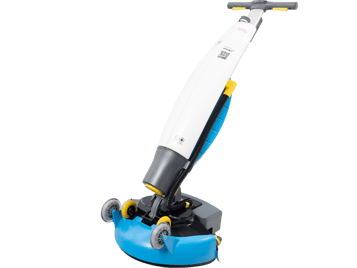 Key design features of the PowerMop CE:
- Front and rear splash guards to contain liquid and particles
- Integrated squeegee and suction-based liquid recovery
- HEPA filtration
- Brushless motor
- Peristaltic pump
- Single-use textile cleaning pads
- Textured polyester cleaning surface
- Polyester foam core and backing
The single-use cleaning pads are designed to provide consistent surface contact while reducing concerns associated with conventional scrubbing brushes.
The system is described as suitable for specified controlled environments, including Grade C and ISO 6 applications, subject to appropriate facility assessment.
Potential operational benefits include reduced operator variability, improved large-area cleaning efficiency, and reduced manual mopping requirements.
The PowerMop CE is positioned as a supplement to manual cleaning rather than a complete replacement, particularly where equipment access or surface geometry requires manual intervention.
Measuring Cleaning Effectiveness Through Turbidity Analysis
Turbidity analysis provides a method of evaluating the amount of contamination removed during cleaning by measuring the cloudiness of recovered cleaning solutions.
The technique is known as nephelometry, and results are expressed in Nephelometric Turbidity Units (NTU).
Higher turbidity in recovered cleaning liquid can indicate that more particulate contamination has been extracted from a surface.
A comparative evaluation examined the PowerMop CE against traditional manual mopping.
Manual mopping vs mechanized mopping in cleanrooms - test conditions:
- Highly textured epoxy-painted flooring
- Visible soil and residue contamination
- Contec NutriClean neutral detergent at a 1:3 dilution
- Approximately 105 square feet of cleaning area
- A single cleaning pass
- Fresh cleaning pads for each method
- Comparison against a conventional manual mopping system
The recovered solution from the PowerMop CE demonstrated higher turbidity and visible sediment than the solution recovered through the manual method.
These findings suggested greater particle and sediment removal under the evaluated conditions.
Importantly, turbidity is an indirect indicator of contamination removal, not a direct measurement of residual surface cleanliness.
Turbidity measurements may support cleaning method comparisons, but they should be interpreted alongside other validation and environmental monitoring information.
Behind the Scenes

 return to overview
 back to top