Understanding Contamination Control Assessments (CCAs)
A Contamination Control Assessment (CCA) is a collaborative, site-specific evaluation of cleaning and disinfection practices within controlled environments. Unlike a formal audit, a CCA focuses on observing actual operational practices, identifying contamination risks, and recommending practical improvements.
Assessments typically evaluate:
- Microbial contamination control
- Material transfer procedures
- Operator cleaning and disinfection techniques
- Cleaning product selection and application
- Disinfectant residues and removal processes
- Alignment with EU GMP Annex 1 and applicable regulatory requirements
The primary objective is to identify opportunities for improving contamination control through direct observation and collaboration with facility personnel.
Why Contamination Control Must Move Beyond Written Procedures
A documented contamination control strategy does not guarantee effective implementation. Differences between written standard operating procedures (SOPs) and actual operator practices can create significant contamination risks.
Common discrepancies include:
- Wiping patterns that differ from approved procedures
- Inconsistent disinfectant application
- Failure to achieve validated contact times
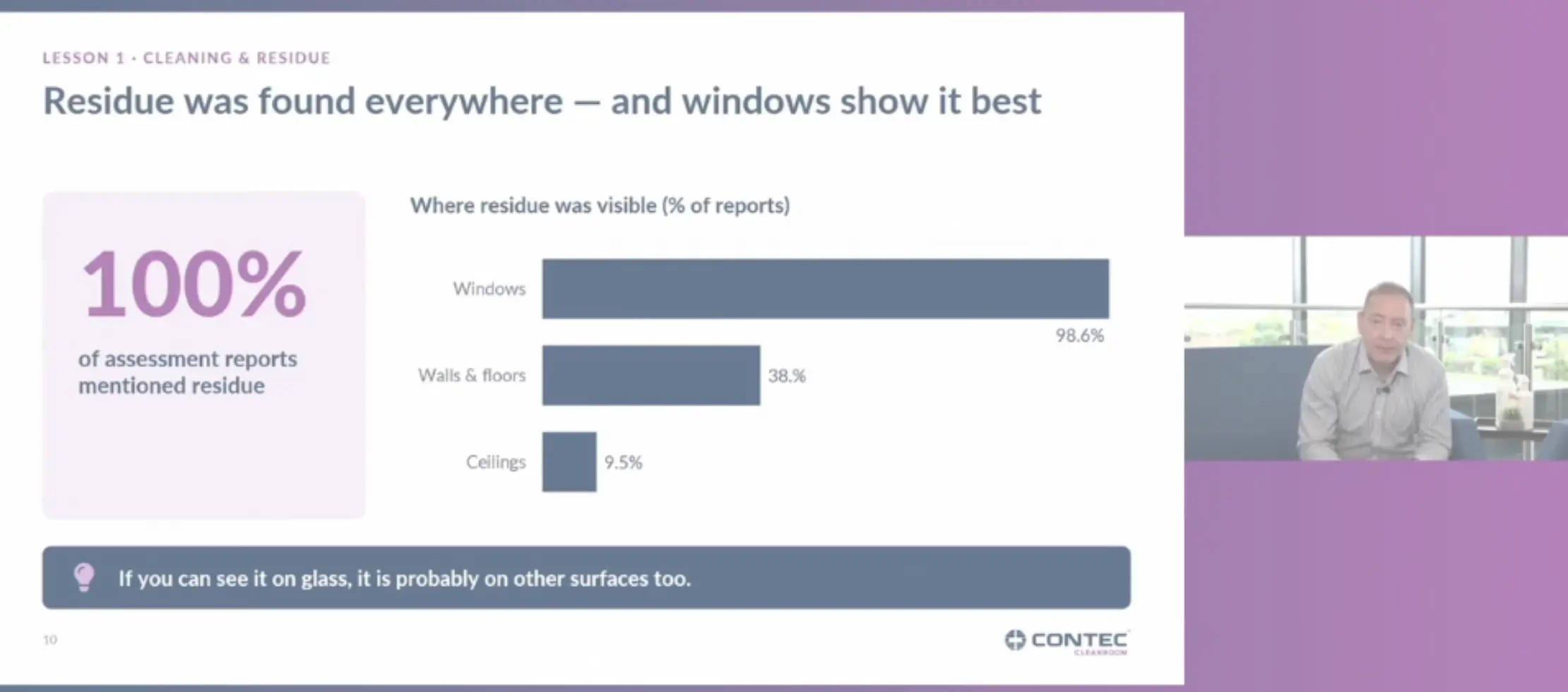
- Inadequate residue removal
- Variations between operators and shifts
EU GMP Annex 1 emphasizes holistic, risk-based contamination control supported by scientific evidence.
Successful contamination control requires aligning documented procedures with consistent operational execution. Simplifying procedures can improve operator compliance and reduce variability.
Cleaning and Residue Removal Gaps in Cleanroom Programs
Cleaning frequently receives less attention than disinfection, despite being essential to the overall contamination control process.
Cleaning and disinfection serve different purposes:
- Cleaning: Removes particles, manufacturing residues, disinfectant residues, and accumulated chemical deposits.
- Disinfection: Reduces viable microorganisms to the required level through validated antimicrobial activity.
Cleaning does not necessarily need to occur immediately before every disinfectant application. The appropriate sequence and frequency depend on product characteristics, residue accumulation, and facility-specific risk assessments.
An effective disinfection program requires a cleaning strategy capable of managing the contamination and residues left behind.
Quaternary Ammonium Compounds: Efficacy and Residue Trade-Offs
Quaternary ammonium compounds (QACs or quats) remain widely used in cleanroom disinfection programs.
Approximately 90% of assessed sites used quaternary ammonium compound-based disinfectants.
Their continued use is associated with several practical advantages:
- Established antimicrobial efficacy
- Long history of cleanroom use
- Broad commercial availability
- Competitive cost
- Generally favorable material compatibility
- Ease of application
However, quaternary ammonium compounds are strongly associated with visible residue accumulation.
Their positively charged molecules can interact with negatively charged surface materials, contributing to persistent deposits.
Facilities selecting QAC-based disinfectants must evaluate the complete operational impact, including:
- Residue accumulation and removal requirements
- Validated wet contact time
- Application volume
- Material compatibility
- Labor and consumable costs
- Operator safety
Disinfectant selection should balance microbial efficacy with residue management and practical application requirements.
Material Transfer Disinfection and Sporicidal Protection
Material transfer represents a significant contamination pathway because equipment and materials may introduce microorganisms from uncontrolled or lower-classification environments into cleanrooms.
The assessments identified substantial variation in transfer disinfection practices.
Alcohol-only transfer disinfection presents limitations because alcohol does not provide effective bacterial sporicidal activity and may require extended contact times against molds.
Sporicidal disinfection can provide broader contamination control during material transfer, particularly at the initial stage of entry into controlled environments.
An effective transfer disinfection strategy should consider:
- Microbial contamination risks
- Material entry points
- Disinfectant spectrum of activity
- Validated contact times
- Application methods
- Facility-specific environmental monitoring data
Transfer disinfection should be scientifically justified rather than based solely on established historical practices.
Alcohol Disinfection: Application Methods and Contact Time Challenges
Alcohol remains a foundational component of cleanroom disinfection programs.
Alcohol effectiveness depends on achieving the validated wet contact time.
Practical limitations include rapid evaporation, flammability, operator exposure, and reduced suitability for large-area application.
Disinfectant contact time considerations:
- Approximately one minute or more for certain vegetative bacteria and yeast applications
- Potentially up to 15 minutes for mold-related efficacy claims
- Reapplication requirements when surfaces dry before the validated contact time
Approximately 70% of assessed sites used spray-only alcohol application rather than presaturated wipes.
Spray application can introduce variability in the amount of disinfectant applied, surface coverage, and operator technique.
Presaturated wipes may improve consistency by delivering a more controlled quantity of disinfectant.
Effective alcohol disinfection requires correct product concentration, application method, surface coverage, contact time, and operator technique.
Operator Technique, Training, and Procedural Consistency
Operator practices directly influence the effectiveness of cleaning and disinfection programs.
Even a validated disinfectant can fail to achieve its intended performance when application methods are inconsistent.
Six essential elements of effective disinfection are identified:
- Correct disinfectant selection
- Correct product concentration
- Appropriate application method
- Complete surface coverage
- Achievement of validated wet contact time
- Consistent operator technique
The final four elements depend heavily on operator execution.
Training should explain not only how to follow procedures but also why each requirement matters.
Important training topics include:
- Proper wiping and mopping techniques
- Disinfectant coverage
- Wet contact time
- Avoiding excessive application
- Residue prevention
- Acceptable cleaning outcomes
- Consistency between operators and shifts
Simplified procedures and ongoing practical training can reduce variability and improve contamination control performance.
Disinfectant Efficacy Validation and Scientific Justification
Disinfectant validation should demonstrate effectiveness against microorganisms relevant to the facility and on representative cleanroom surfaces.
Manufacturer efficacy testing provides important supporting information, but it does not automatically demonstrate effectiveness under every site's operating conditions.
EU GMP Annex 1 supports the use of manufacturer data as part of a scientifically justified validation strategy.
Facilities should evaluate:
- Manufacturer efficacy studies
- Relevant environmental isolates
- Representative cleanroom surfaces
- Problematic or difficult-to-disinfect materials
- Actual application conditions
- Gaps between available evidence and site-specific requirements
The central validation question is not simply whether a disinfectant kills microorganisms, but whether it can achieve the required performance under the facility's intended conditions of use.
Sporicidal Disinfectant Selection and Microbial Contamination Risks
Sporicidal disinfectants are essential for controlling bacterial spores and addressing persistent contamination risks.
Sporicidal selection should consider more than antimicrobial efficacy:
- Contact time required for sporicidal activity
- Operator exposure limits
- Residue generation
- Material compatibility
- Practical application
- Surface wetness requirements
Hydrogen peroxide can demonstrate bacterial sporicidal efficacy but may require extended contact times and additional occupational exposure controls.
Establishing Contamination Control Programs in New Facilities
New cleanroom facilities offer an opportunity to establish effective contamination control practices before unsuitable procedures become embedded.
New facilities may lack:
- Established cleaning procedures
- Mature disinfection programs
- Historical environmental monitoring trends
- Site-specific microbial data
- Long-term operational experience
Early planning should address cleaning methods, disinfectant selection, material transfer procedures, operator training, and validation requirements.
Decisions should be documented within the Contamination Control Strategy.
Establishing scientifically justified practices during facility planning is generally easier than correcting longstanding procedural weaknesses after operations have begun.
Evaluating Cleanroom Cleaning Equipment and Methods
Traditional bucket systems are widely established but may introduce process complexity and operator variability.
Laundered microfiber mops require consideration of fiber degradation and embedded particle contamination after repeated laundering.
Mini environmental mops can support cleaning in controlled spaces such as isolators and laminar airflow environments.
Mop wipes may deliver limited cleaning solution and require frequent replacement.
Cleaning equipment should be selected based on facility-specific requirements rather than inherited historical practices.
Turning Contamination Control Assessments into Measurable Improvements
Facilities demonstrating stronger contamination control practices shared several characteristics:
- Understanding why procedures exist
- Providing ongoing education
- Recognizing operational weaknesses
- Using simple, consistent application techniques
- Making risk-based decisions
- Supporting disinfectant selection with scientific evidence
- Regularly reviewing and improving established procedures
The value of a CCA extends beyond identifying deficiencies. Sustainable improvement depends on converting observations into practical actions that operators can consistently implement.
 Contec Cleanroom
 Life Sciences, Microelectronics, Cleaning, Contamination Control, Webinar

 return to overview
 back to top