Table of Contents
- Knowledge Base
- Cleanroom Disinfectants
- What Are the Rules for Validating a Disinfectant in Pharmaceutical Cleanrooms?
 Contec Cleanroom
 Life Sciences, Disinfectants, Article
What Are the Rules for Validating a Disinfectant in Pharmaceutical Cleanrooms?
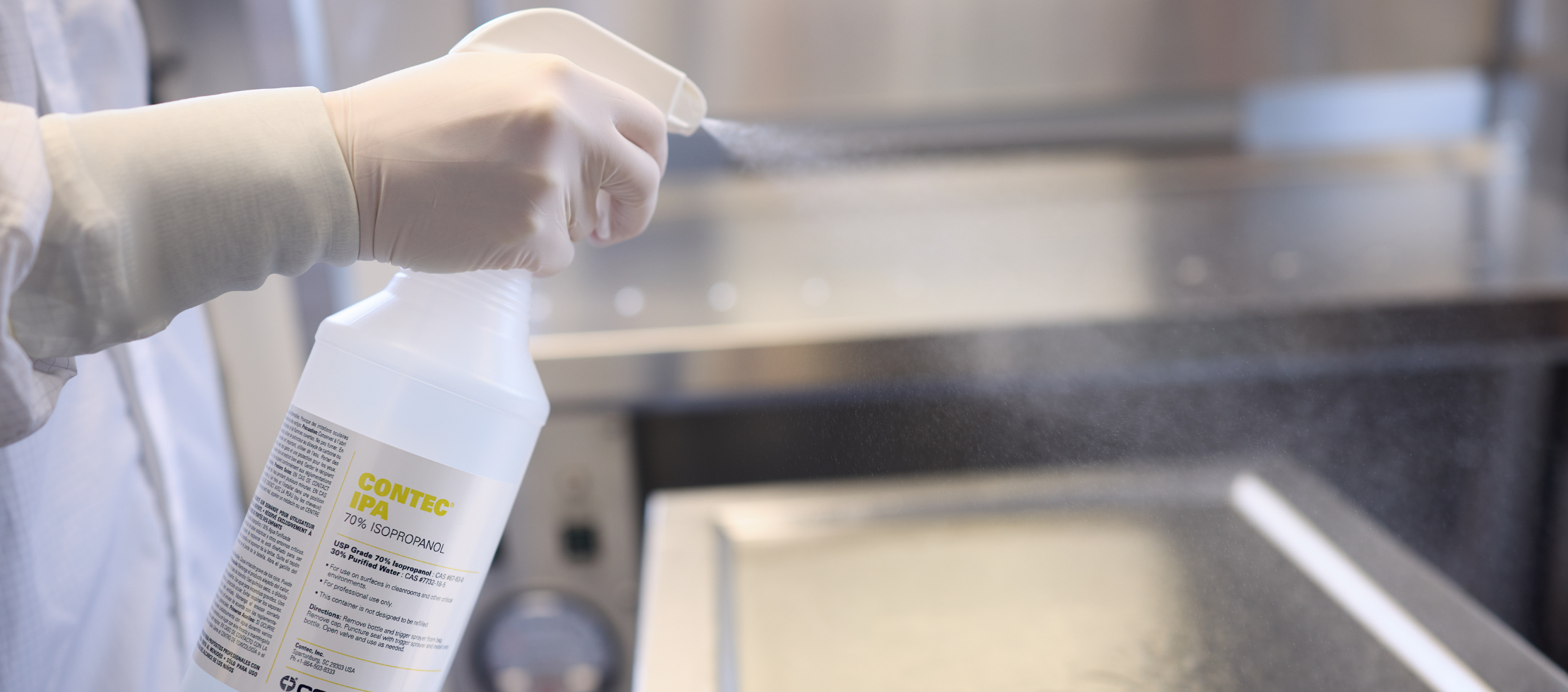
Disinfectant validation in pharmaceutical cleanrooms ensures that disinfectants can consistently achieve effective microbial kill on relevant cleanroom surfaces while meeting regional regulatory requirements. Validation involves more than efficacy testing alone and includes factors such as wet contact time, sterility, residues, application methods, safety, storage, and compliance with regulations including EU BPR, EPA, GMP, and international efficacy testing standards.
Why Is Disinfectant Validation Important in Pharmaceutical Cleanrooms?
Life science cleanroom facilities must demonstrate that the disinfectants they use can achieve effective microbial kill across a range of surface types. Because pharmaceutical cleanrooms contain critical manufacturing environments, disinfectant validation forms an essential part of contamination control strategies.
Disinfectant validation includes many factors beyond efficacy testing alone, including:
-
Wet contact time
-
In vitro and in-use performance
-
Unopened and in-use shelf life
-
Sterility
-
Residue considerations
-
Application methods
-
Storage and disposal
-
Health and safety
-
Manufacturer audits
-
Surface-specific microbial kill performance
Cleanroom operators must understand both regulatory expectations and the efficacy standards required for the markets in which they operate.
Which Regulatory Bodies Oversee Disinfectant Validation?
The regulatory landscape for disinfectant validation can be complex because multiple organizations influence requirements.
Four main groups of organizations:
-
Regulatory bodies responsible for ensuring disinfectants are safe and effective
-
Regulatory bodies responsible for medicinal product safety
-
Organizations with approved efficacy testing methods
-
Supporting organizations that publish guidance documents
Examples of commonly referenced organizations and standards include:
-
FDA
-
EPA
-
ECHA
-
AOAC
-
ASTM
-
USP
-
EN standards
-
EU GMP
Regulatory expectations differ between regions, particularly between Europe and the United States.
What Is the EU Biocidal Products Regulation (BPR)?
In Europe and the UK, disinfectants must comply with the EU Biocidal Products Regulation (BPR) and GB BPR before they can legally be placed on the market.
Overview of BPR:
-
Since September 2013, the BPR replaced national biocide registrations in the EU
-
The European Chemicals Agency (ECHA) implements the regulation
-
All biocidal products require authorization before market placement
-
Active substances must be approved before product authorization
The regulation applies regardless of disinfectant format, including:
-
Trigger sprays
-
Presaturated wipes
-
Saturate-at-point-of-use wipes
-
Two-part systems
-
Fogging systems
-
Gassing systems
Intended use determines whether a product is considered a biocide, even if no antimicrobial claims appear on packaging or marketing materials.
How Does Disinfectant Regulation Differ in the United States?
In the United States, disinfectants are regulated by the Environmental Protection Agency (EPA) under the Federal Insecticide, Fungicide, and Rodenticide Act (FIFRA).
Disinfectant manufacturers in the US must:
-
Register products with the EPA
-
Register products with individual states where products are sold
-
Demonstrate safety and efficacy
-
Submit efficacy data supporting microbiocidal claims
The EPA also expects:
Compliance with Good Laboratory Practice Regulations (GLP)
Testing at the lowest level of active ingredient concentration
Use of specified reference microorganisms
Use of approved application techniques
EPA expectations differ from European requirements, creating additional complexity for multinational cleanroom operations.
Which Disinfectant Efficacy Test Methods Are Commonly Used?
The article explains that multiple efficacy testing standards are available, although many were not specifically developed for cleanrooms.
Commonly referenced methods include:
-
CEN methods
-
OECD methods
-
ISO methods
-
AOAC methods
-
ASTM methods
-
US-EPA methods
-
VAH methods
-
AFNOR methods
ECHA recommends using internationally recognized standards whenever possible, with CEN methods strongly preferred in Europe.
Why Are Cleanroom Disinfectant Tests Different From Standard Tests?
Traditional disinfectant efficacy methods were not specifically written for cleanroom environments. As a result, standard microbial test expectations may not always be suitable for pharmaceutical cleanrooms.
Cleanrooms require consideration of unique conditions including:
-
Low contamination environments
-
Specialized surface materials
-
Realistic contact times
-
Surface wiping methods
-
Mechanical action during application
ECHA recognizes cleanrooms as a special case and allows modifications to standard testing conditions when justified.
For example:
-
Water for Injection (WFI) may be used as the interfering substance
-
Contact times may be adjusted if justified
-
Surface-specific testing may be required
What Factors Should Be Considered During Disinfectant Efficacy Testing?
There are several important variables that should be evaluated during disinfectant efficacy testing:
-
Temperature
-
Contact time
-
Neutralization validation
-
pH
-
Surface texture
-
Repetition of tests
-
Pass criteria
-
Interfering substances
Contact time must remain practical for real-life cleanroom operations and that testing conditions should reflect actual product use.
How Are Disinfectant Wipes Validated?
ECHA recommends:
-
Phase 1, Step 1 testing using fluid extracted from the wipe
-
Phase 2, Step 2 testing with mechanical action
This reflects the real-world use of disinfectant wipes within cleanrooms, where wiping motion contributes to contamination removal and microbial reduction. Product format does not remove the requirement for authorization or validation.
\What Active Ingredients Are Commonly Used in Cleanroom Disinfectants?
There are several common active ingredients used in cleanroom disinfectants, including:
-
IPA
-
Denatured ethanol
-
Hypochlorites
-
Hydrogen peroxide
-
Peracetic acid
-
Quaternary ammonium compounds
-
Phenols
Each active ingredient may have different regulatory approval timelines and efficacy expectations depending on the region.
How Does Annex 1 Impact Disinfectant Validation?
There is increasing regulatory focus on disinfectant validation within pharmaceutical manufacturing. The revised EU GMP Annex 1 strengthens expectations around contamination control and disinfectant effectiveness on cleanroom surfaces.
Manufacturers and cleanroom operators must ensure:
-
Appropriate disinfectant efficacy testing
-
Validation under actual use conditions
-
Surface-specific effectiveness
-
Practical application methods
This places greater emphasis on robust disinfectant validation programs aligned with real cleanroom conditions.
Conclusion
Disinfectant validation in pharmaceutical cleanrooms requires a combination of regulatory compliance, efficacy testing, and practical application validation. As global regulations evolve, cleanroom operators must ensure disinfectants are validated for the surfaces, conditions, and methods in which they are actually used.
Key Takeaways
-
Disinfectant validation involves more than efficacy testing and includes shelf life, residues, sterility, and application methods.
-
EU and US disinfectant regulations differ significantly, requiring region-specific compliance strategies.
-
ECHA and EPA both require efficacy data using approved testing methods and reference organisms.
-
Cleanroom environments require modified testing approaches because standard methods were not specifically designed for cleanrooms.
-
Disinfectant wipes must be validated using both extracted fluid testing and mechanical action testing.
 return to overview
 back to top