Why Wiping Is Essential for Cleanroom Contamination Control
Wiping is a fundamental cleaning and disinfection method used throughout controlled environments. Cleanroom wipes support contamination control by physically collecting particles and providing a controlled method of applying cleaning agents and disinfectants.
Effective wiping provides several advantages:
- Physically removes nonviable particles from cleanroom surfaces.
- Traps contamination within the wipe substrate.
- Reduces the potential for particles to be redistributed onto cleaned surfaces.
- Provides controlled application of cleaning solutions and disinfectants.
- Introduces mechanical action that can disrupt surface-associated microbial contamination.
- Supports standardized procedures that operators can be trained to perform consistently.
The microscopic structure of a wipe contributes to its effectiveness. Fibers create multiple small contact points and openings that support particle collection and retention.
Moistening a wipe can improve surface contact and increase the likelihood that particles remain within the wipe rather than being redeposited.
Wipe selection must account for the intended activity because the characteristics required for particle removal may differ from those needed for disinfectant application.
Understanding Cleaning Versus Disinfectant Application
Cleaning and disinfection require different wipe performance characteristics.
Cleaning focuses on physically removing particles, soil, and other nonviable contamination. The ideal wipe collects and retains contamination while minimizing redeposition.
Disinfectant application focuses on delivering a consistent, visible film of disinfectant across a surface for the validated wet contact time.
Presaturation levels may therefore differ depending on whether a wipe is designed primarily for cleaning or disinfection.
Excessively saturated cleaning wipes can increase the risk of particle redeposition, while insufficiently saturated disinfectant wipes may fail to deliver the required liquid film.
The primary application should be established before selecting a wipe substrate or saturation format.
Why No Cleanroom Wipe Is Completely Lint-Free
No cleanroom wipe is entirely free from particle or fiber release.
The term lint-free is commonly used in general cleaning and product marketing, but it does not accurately describe cleanroom wipe performance.
Even high-performance, extensively processed wipes can release measurable particles.
Similarly, labels such as Grade A wipe or ISO 7 wipe should not be interpreted as formal, standalone classifications of wipe cleanliness.
Cleanroom classification applies to the controlled environment, while wipe suitability depends on the product's characteristics and the requirements of the intended application.
Appropriate wipe selection requires evaluating:
- Measured particle and fiber release
- Cleanroom classification
- Criticality of the manufacturing process
- Required cleaning or disinfection performance
- Surface compatibility
- Sterility and endotoxin requirements
- Applicable facility procedures
A wipe should be selected because its documented performance meets the needs of a particular cleanroom activity—not simply because it is marketed for a particular cleanroom grade.
Five Key Performance Characteristics of Cleanroom Wipes
Cleanroom wipe performance is assessed through five main characteristics that are commonly reported in manufacturers' technical data:
- Cleanliness
- Absorbency
- Basis weight
- Residues and extractables
- Physical properties
Particle and fiber counts should be evaluated separately. Fibers are identified as particles longer than 100 microns in the testing terminology discussed.
Cleanroom wipe data may also include ionic contamination, nonvolatile residues, and other extractable substances.
Laboratory results must be compared carefully. Particle and fiber measurements can vary between testing laboratories and methodologies. Meaningful product comparisons should use the same laboratory, test method, and applicable IEST procedures wherever possible.
Lower particle and fiber release generally corresponds to more highly processed and more expensive wipes.
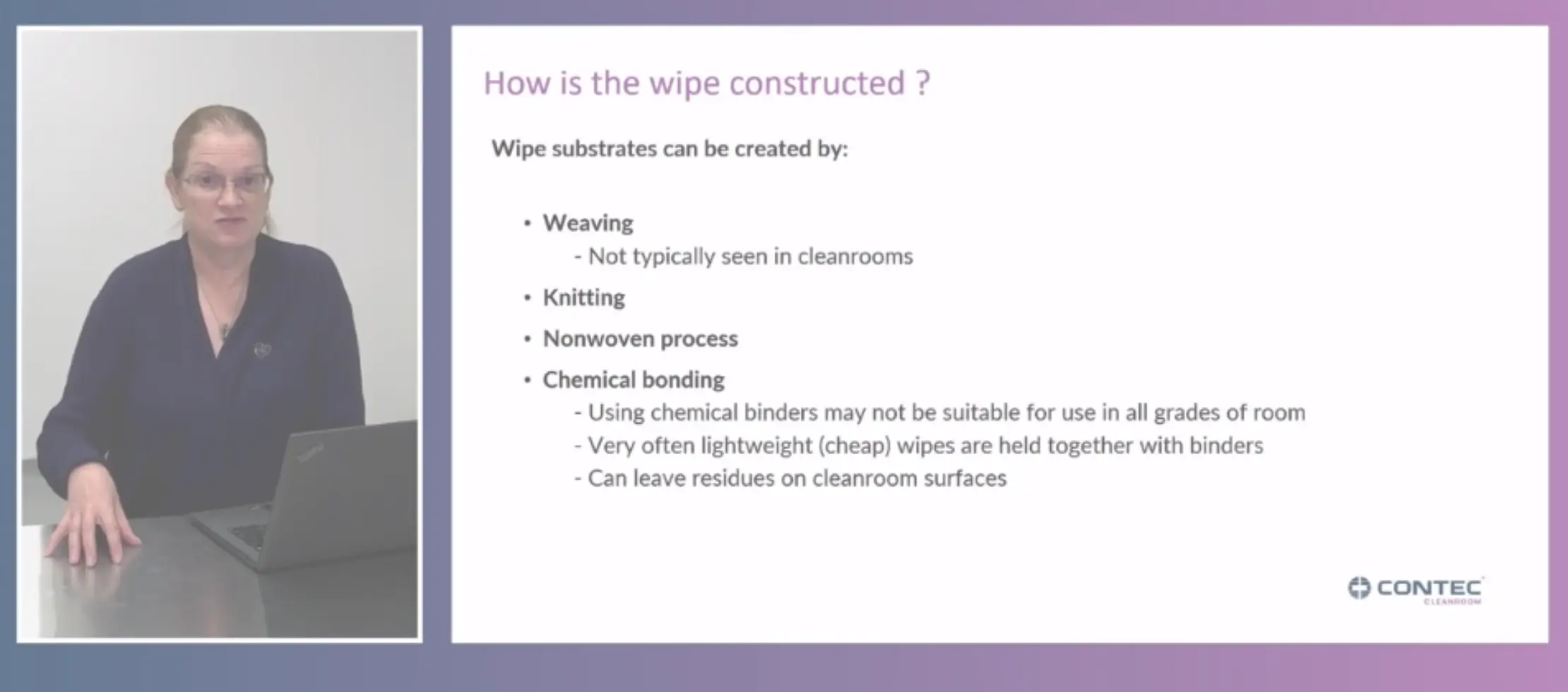
Understanding Cleanroom Wipe Substrates and Construction
Cleanroom wipes are manufactured using different fibers, construction methods, and finishing processes. These characteristics determine cleanliness, absorbency, durability, chemical compatibility, and cost.
Five variables influence the final performance of a cleanroom wipe:
- Fiber material
- Fiber or filament size
- Fabric construction
- Conversion of fabric into individual wipes
- Additional processing, including treatment or laundering
Synthetic fibers include polyester, polypropylene, and nylon. They generally offer relatively low particle release and good chemical compatibility, although their inherent absorbency may be limited.
Cellulose-based fibers provide greater absorbency but may produce more particles and have reduced durability in certain applications.
Blended materials combine characteristics from different fibers to balance performance and cost.
Wipe construction is broadly divided into knitted and nonwoven materials.
Nonwoven manufacturing methods include hydroentangling, spunlacing, meltblowing, airlaying, wetlaying, spunbonding, and carding.
Chemical bonding agents may be unsuitable for certain cleanroom applications because binders can introduce residues or interact with cleaning and disinfection solutions.
Comparing Nonwoven, Knitted Polyester, and Microfiber Wipes
Different wipe substrates offer distinct advantages for cleaning, disinfection, liquid absorption, and contamination removal.
Microfiber is defined by fiber fineness rather than a single construction method. A microfiber filament is conventionally defined as having a linear density below one decitex per filament.
Split microfiber increases the effective surface area available for collecting particles and residues.
Nonwoven wipes generally offer a cost advantage and good absorbency, but may be less durable than knitted synthetic wipes, especially on abrasive surfaces.
Knitted polyester wipes typically provide lower particle and fiber release, making them attractive for critical cleanroom applications.
How Wipe Edge Finishing Affects Particle and Fiber Release
The method used to convert fabric into individual wipes influences the number of particles and fibers released during use.
Cut edges can expose fibers and contribute to particle shedding.
More controlled edge-finishing methods, including sealed edges, can reduce fiber release and improve suitability for critical applications.
Edge selection should consider:
- Particle and fiber cleanliness requirements
- Cleanroom classification
- Abrasiveness of the surface
- Required durability
- Potential contact with sensitive equipment
- Cost
Edge finishing is one part of overall wipe performance. A sealed-edge wipe should not automatically be assumed to be suitable for every application without considering its substrate, cleanliness data, and intended use.
Sterility, Endotoxins, and Cleanroom Classification Requirements
Sterility and endotoxin control are separate considerations when selecting wipes for pharmaceutical cleanrooms.
Sterilization addresses viable microorganisms, while endotoxins are bacterial components that can remain after microorganisms have been killed.
A sterile wipe is therefore not necessarily a low-endotoxin wipe.
Important considerations include:
- Grade A and B applications may require sterile wipes.
- Product-contact applications may require defined endotoxin limits.
- Synthetic materials can support lower endotoxin levels than some natural-fiber materials.
- Dry wipes can often be sterilized by gamma irradiation.
- Gamma irradiation may affect certain presaturated wipe formulations or their chemical components.
- Sterility requirements in lower-grade areas should be established through the facility's Contamination Control Strategy.
Cleanroom classification remains important, but it is not the sole determinant of wipe selection.
A Grade C area containing an isolator or another critical process may require a higher-performance wipe than would ordinarily be selected for routine Grade C cleaning.
Sterility, endotoxin specifications, and particle cleanliness must each be evaluated independently.
Understanding Wipe Absorbency and Disinfectant Compatibility
Absorbency determines how much liquid a wipe can hold, while liquid-release behavior determines how effectively that liquid can be transferred to a surface.
These properties are related but not interchangeable.
For example, cellulose-containing wipes absorb liquid readily, but may retain some of that liquid within their fibers. Polyester and polypropylene can release liquid more readily, depending on their construction and treatment.
Microfiber structures can provide high liquid capacity and improved surface coverage.
Chemical compatibility is equally important because the wipe substrate can influence both the stability and delivery of a disinfectant.
Important interactions include:
- Hydrogen peroxide: May degrade certain cellulose-containing substrates and reduce the available disinfectant concentration.
- Hypochlorite-based products: Can attack cellulose-containing materials.
- Quaternary ammonium compounds: Positively charged actives may bind to certain fibers, reducing the amount delivered to the surface.
- Alcohol solutions: Generally demonstrate compatibility with a wide range of wipe substrates.
Disinfectant qualification should consider the wipe and chemical as a combined system.
Manufacturer data should demonstrate that the disinfectant remains effective when incorporated into the wipe, including appropriate active concentration and stability throughout the claimed shelf life.
Choosing Between Dry and Presaturated Cleanroom Wipes
Dry wipes and presaturated wipes offer different levels of control over disinfectant application.
When dry wipes are saturated at the point of use, operators influence how much solution is applied, how evenly the wipe becomes saturated, and how much liquid is subsequently released.
These variables can introduce inconsistencies between operators and cleaning events.
Presaturated wipes provide a more standardized application process.
Benefits include:
- Manufacturer-controlled saturation levels
- Consistent liquid loading and release
- More uniform surface coverage
- Reduced operator variability
- Fewer opportunities for under- or oversaturation
- Reduced airborne droplet generation compared with spraying
- Easier procedural standardization
- Support for repeatable cleaning and disinfection practices
However, presaturation alone does not guarantee effective disinfection.
The substrate must remain compatible with the disinfectant and deliver sufficient active ingredient to maintain the validated wet contact time.
Facilities should evaluate the complete wipe-and-disinfectant system rather than relying solely on the antimicrobial claims of the liquid formulation.
Matching Wipe Selection to Cleanroom Applications
Selecting the appropriate wipe requires a structured evaluation of the activity, environment, and performance requirements.
The primary application should be established first.
Balancing Performance, Cost, and Sustainability
Cleanroom wipe selection frequently involves trade-offs between cleanliness, absorbency, durability, chemical compatibility, cost, and sustainability.
Higher-performance wipes generally cost more, particularly when they incorporate specialized fibers, controlled edge finishing, and cleanroom laundering.
However, selecting the most expensive wipe does not necessarily provide the best outcome for every application.
A less expensive wipe may be entirely suitable for general cleaning in a lower-grade environment, while a more costly wipe may be justified for a critical process.
Sustainability considerations include:
- Wipe consumption per cleaning activity
- Surface coverage per wipe
- Waste generated during cleaning
- Availability of recycled polyester materials
- Durability and performance requirements
- Total consumable cost
Improved liquid delivery and surface coverage may reduce the number of wipes needed for a cleaning or disinfection process.
Recycled polyester options may also support facility sustainability objectives, provided they meet the necessary cleanliness and performance requirements.
The goal is to select the most appropriate wipe for the intended process rather than the highest-specification wipe available.
 Contec Cleanroom
 Life Sciences, Microelectronics, Cleaning, Wiping, Webinar




 return to overview
 back to top